New Guitar: Early Kramer Pacer Custom

Lately, believe it or not, I have been trying to downsize my collection. It’s hard to turn off my “jump on a good deal” impulse, but I’ve really been trying to really think about what guitars I want to keep. I don’t own everything on this site anymore, but I do still have a lot of guitars and sometimes I feel like I spend more time shopping, researching, and writing about guitars than I do actually playing them and I’m a worse musician for it.

Part of that soul-searching process has led me to identify that I have a real soft spot for the earliest wood necked Kramer guitars. There’s something about them that is just special, a sense of occasion to getting one out to play it and being immersed in it. The smell of the old leather in the case reminds me of my Members Only jacket, the weight of the substantial maple body pulling on my shoulder, the feel of the old brass fittings and small frets (what we’d describe as “vintage” frets today). It’s just endlessly fascinating to me to play an instrument that was groundbreaking and modern for the time, nearly 45 years after it was built.

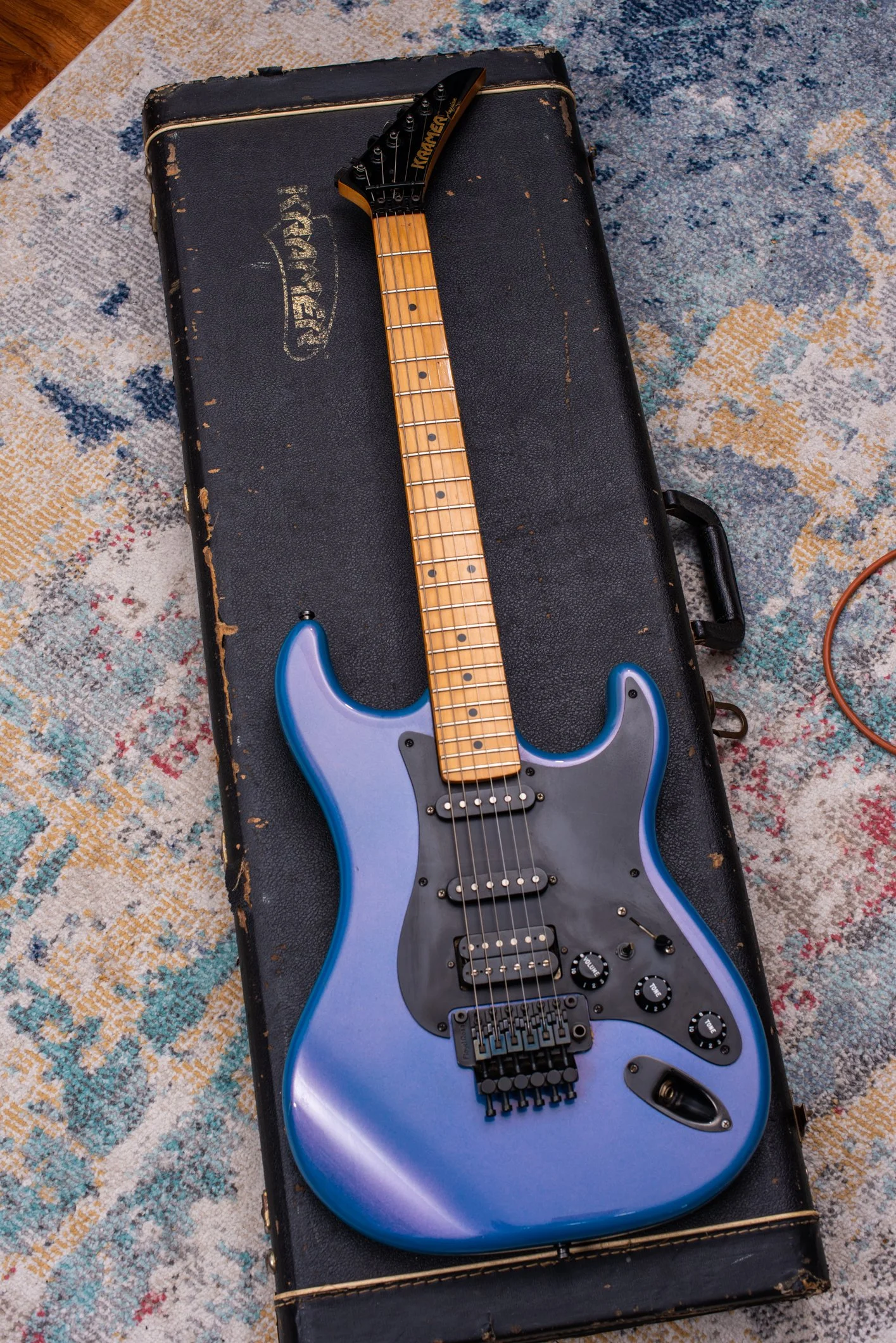
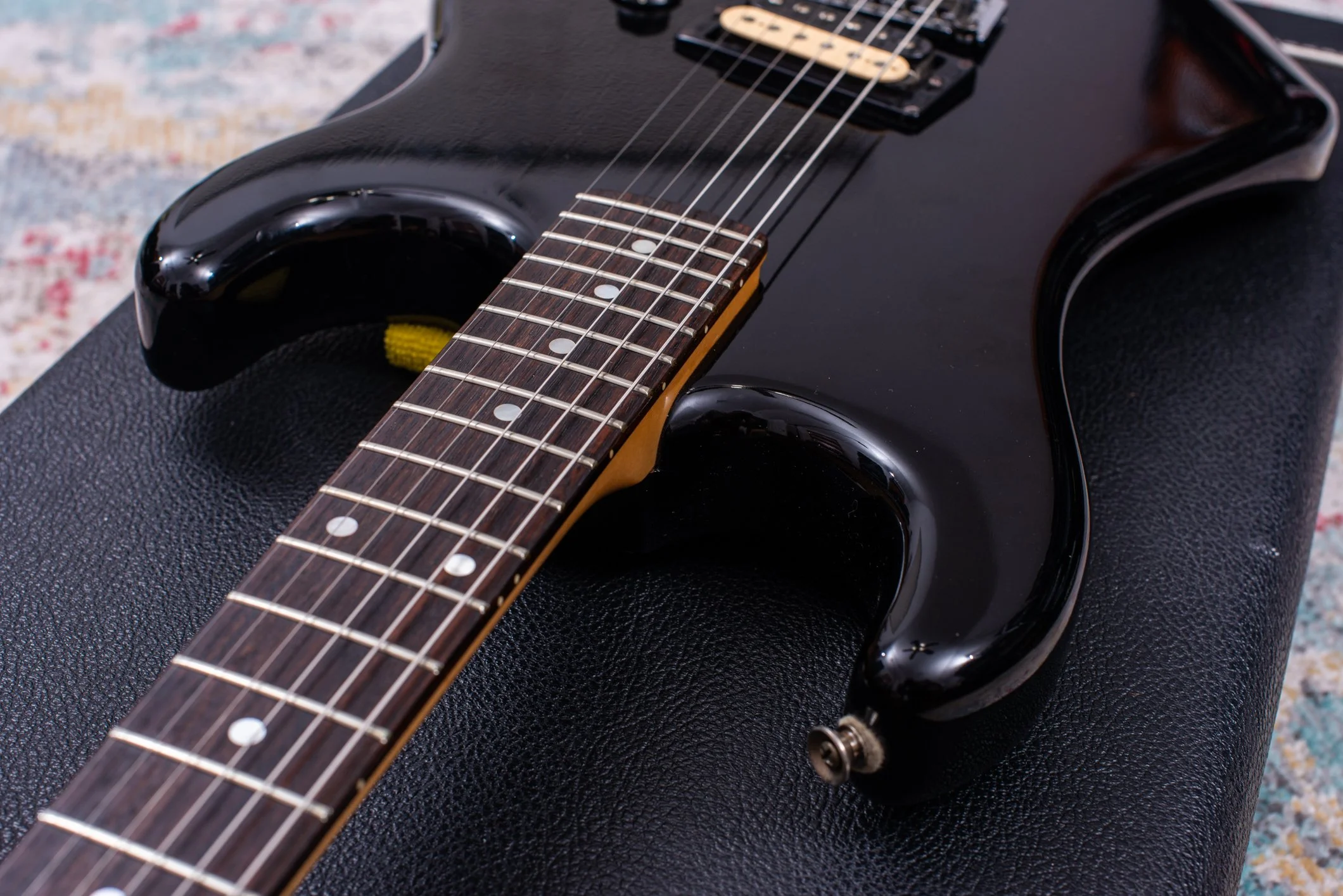
That brings me to today’s guitar, which is a 1982 (or perhaps late ‘81) Kramer Pacer Custom in a gorgeous “blue burst” finish.

There are a few noteworthy features of this very early serial number (B0392). For context, wood necked Kramers started around A7000 and rolled over into “B” after A9999. Within that rough range, many were still aluminum necks like the “Duke,” and quite a few were basses, so this is definitely one of the earliest guitars with the “beak” headstock shape.

The first thing I want to point out is the bridge, which ties in to the name of this model. This is a Pacer “Custom,” which at this time in Kramer history means it has two humbucker pickups and a brass 6-screw standard tremolo. The better known Pacer “Imperial” in these early days had the same HH configuration but with the ESP Flicker tremolo. By 1982, the Imperial was upgraded to the “Edward Van Halen Tremolo” which was the Rockinger bridge, but the Pacer Custom kept the standard tremolo. Then of course by 1983 you’d start to see Floyd Rose bridges replacing the Rockingers on Imperial models and the Custom model with its standard bridge was dropped entirely by then. Technically you could still order the Flicker bridge throughout this time but it was no longer on the standard catalog models.

The “Custom” moniker did return in mid-1986 but this was an entirely different guitar, using a different body shape, floyd rose bridge, and HSS pickup configuration. This model quickly became the “Pacer Custom I” because a similar model “Pacer Custom II” came out not long after with the same basic features but a different control scheme. These have their own history to dive into but I’ll save that for a future article.
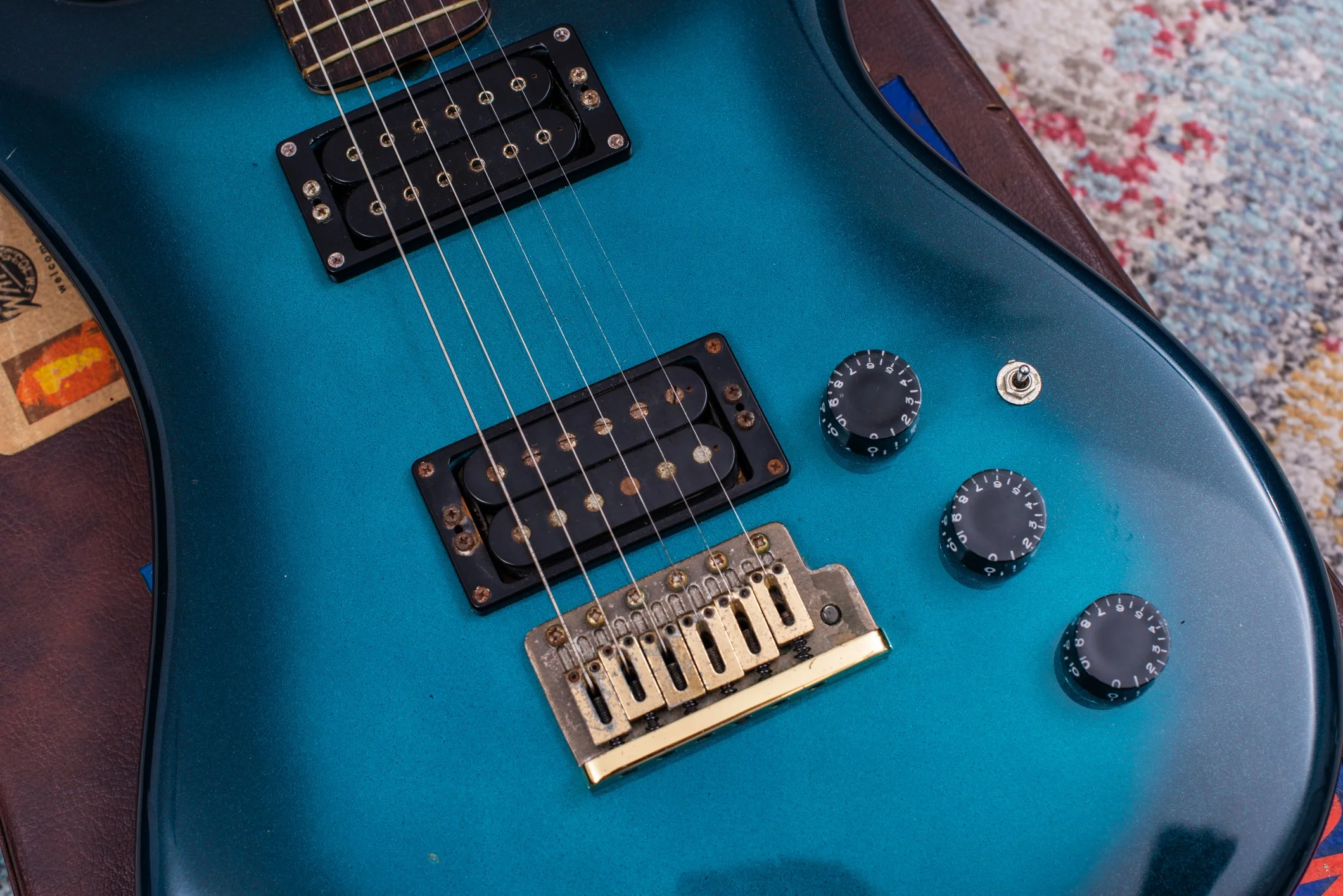
Back to this guitar, it sports an interesting brass trem with a much thicker plate where the saddle screws are located and larger base plate. I have seen this bridge on a handful of other examples and it is on the 1981 catalog page, but I’ve had guitars with lower and higher serial numbers than this with a more normal looking bridge (similar to early Charvel San Dimas brass trems), so I’m not sure what these bridges are exactly. The sharp eyed amongst you may have already noticed that the trem arm screw slot has the broken off end of a trem arm inside… blame that one on Guitar Center, who stupidly shipped this guitar to me with the trem arm installed inside the case. It arrived with the case partially open and the trem arm bent beyond use, and as I carefully tried to unscrew it, it snapped off. Really a shame as 1981 brass trem arms aren’t exactly common, but the good news is that after taking these photos I was able to carefully unscrew the broken piece.

It appears at some point that the neck humbucker was replaced as well. Most likely this guitar had two standard Schaller humbuckers like the one in the bridge position (which is now called “Golden 50,” but back then was called the “Ultra Spec”), but the neck pickup is another 80s-era Schaller called the “2-in-1” with hex poles. I like both of these pickups so I can’t really complain, but if I happen across another standard Schaller I may swap that in so the pickups match stock, and the 2-in-1 would be stock on early 80s Pacer Deluxes so it’s always nice to have an extra for the spare parts bin.

It’s also worth mentioning that rosewood fretboards were uncommon at this time, with the rule of thumb being that for every 10 necks Kramer made, 9 of them were maple fretboards during the “strat head” era, and more rosewood being available during the “beak” era. This rule can be reversed for the pointy era, where rosewood became the much more common fretboard material. This makes my 6th Rosewood beak neck out of 18 total that I’ve owned, so my anecdotal evidence suggests roughly 1/3 of beak necks might be Rosewood. None of my Rosewood necks have a skunk stripe, but supposedly some do - I’d be really interested to see one if someone reading this has one like that.

Bringing things back around to where we started, this is the perfect example of a guitar I find myself wanting to hang on to even as I cull the rest of my collection. I know it seems a little disingenuous to say that as I’ve only had it for a few days, but it’s such a great snapshot into history. It’s not the original Kramer case, but you can tell the previous owner really cared about this guitar and was clearly a very big fan of The Who. The case is covered in concert and radio stickers dating from 1982 and it’s such a cool piece that calls back a strange sense of nostalgia for a time that I wasn’t even alive for.

Since I started this site, people occasionally reach out to me via email and share stories of a parent, relative, or friend, and their connection to an instrument I now own. I really appreciate those and it’s nice to draw a connection between people’s experiences and a physical object like a guitar.
More pictures here

New Guitar: Black Kramer Baretta

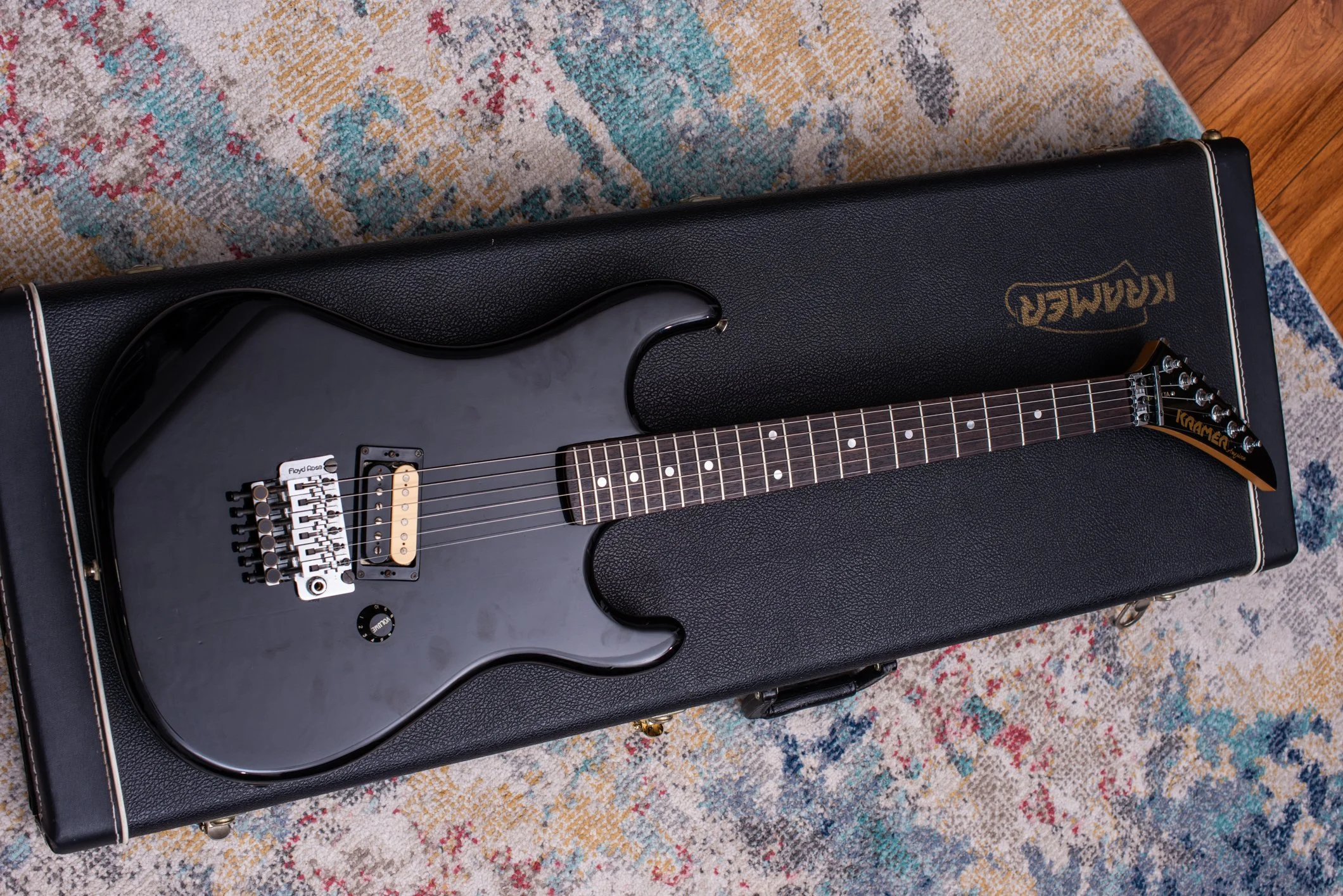
I’m not the biggest Baretta guy, even though it’s probably Kramer’s most famous model with its ties to Eddie Van Halen. However I am a fan of a good deal so I scooped this one up from - surprise - the Guitar Center used listings.

It’s not the most exciting guitar at first glance, but its simplicity does have a certain appeal. The black finished body is in good condition although it has a lot of polishing swirls and the color really shows any finger prints, scratches, or dirt even after a cleaning. I can tell this was a very well taken care of guitar though, even the case looks nearly brand new with barely a scratch on it, the neck is spotless, and the fretboard very healthy looking (clearly was cleaned/oiled regularly).

The previous owner swapped the hardware over to chrome, but it’s all period correct parts. Personally I’d prefer the black, and I do have a spare black Floyd Rose but I used my last set of black Schaller tuners on that flip flop blue Pacer Deluxe I wrote about a few weeks ago - I’ll see what I can find later but most likely I’ll be converting this back to black hardware. They also swapped the volume knob for an odd gold top hat knob with “tone” on it, so I swapped that for a spare strat-style Volume knob which would’ve been the factory correct knob type. I think I have a pair of black schaller strap buttons too.

Luckily the owner didn’t swap out the important parts, primarily the original Seymour Duncan SH-4 JB pickup, wound by Marcela Juarez, in reverse zebra color. I’m not one to believe some certain pickup or winder is “magic” as far as tone, but it’s just the truth that these pickups sound great and are worth a pretty penny if you can even find one. Out of the six 80s Barettas I’ve owned, half of them had this pickup removed which is a bit of a shame. I do really appreciate originality when it comes to collecting guitars, but with prices on vintage 80s Zebra JBJ’s running $250+, I just can’t possibly justify that kind of cost for what is essentially a $70 pickup with one cream coil. Even all black JBJ’s are running into the $200 range these days according to Reverb which kind of blows my mind. I know, with my attention to detail on collecting, you’d think I’d be into that sort of thing but I’m a bit too pragmatic for that.

I’ll take new photos once I get it moved over to black hardware, but I’m no hurry and the guitar plays great as-is so I’ll enjoy it for a while. I’ve had multiple black on black guitars, even including another Baretta with black/black so the chrome is a nice change of pace to add some pop to an otherwise plain instrument.

More photos here

New Guitar: Kramer "The Pacer" Cream/Tortoiseshell

I don’t often visit the listings on MusicGoRound, but I do check occasionally and happened to spot this one - I’m guessing before anyone else did because it was very fairly priced. It arrived without a case but very safely packed (Guitar Center could use a lesson from these guys) and really great condition. This came from the Kenosha WI location, so top marks to them.

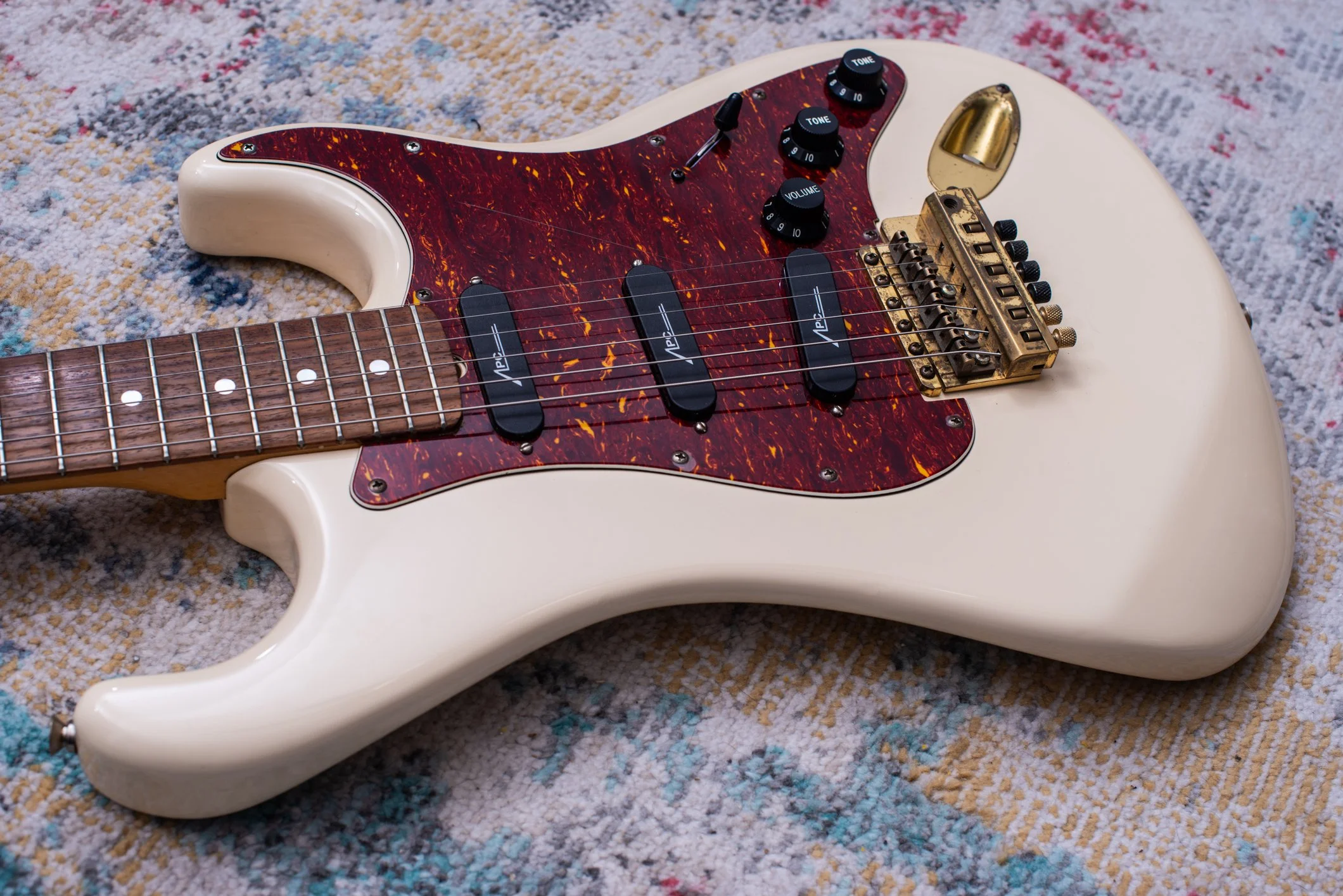
This is a fairly unique and uncommon model that only existed in the early wood-neck Kramer era, only made from 1982-1983. Most of the ones I have seen are similar to this example, although they were technically available in other color combinations almost all of them are cream colored bodies with red tortoise pickguards, and this is the second one like that I’ve had. My first one (an earlier serial number) has a maple fretboard and oil finished neck, but this one has a rosewood board and glossy lacquer - just enough of an excuse to keep both!

The key feature of “The Pacer” models is the pickguard and triple single coil pickup arrangement, and all of these models came with gold/brass hardware and the Rockinger bridge. Very early examples have the Strat style “P” headstock shape, but most of these will have the beak shape as they came out later than the more common Pacer models like the Imperial or Special. There is a late “The Pacer” in the 1983 catalog which sports chrome hardware and an Original Floyd Rose, and by this time the Pacer Deluxe also existed with its black pickguard, many more color options, and H-S-S pickup layout. I have never seen another “The Pacer” equipped with a Floyd besides the one in the catalog. Interestingly, these models also used 11-hole pickguards, while the later Pacer Deluxes used the “vintage” 8-hole guards (which Fender only used from 1954-1959, excepting reissue/signature models).

There are a few changes from stock on this one. First, all of the fine tuners on the Rockinger have been replaced, which is too bad - those screws are impossible to find, though it is pretty minor. Next is the removal of the Rockinger locking nut, replaced with a standard string tree. If I happen across a Rockinger string lock I’ll restore it, but they are nearly impossible to find and objectively a downgrade so I’m not too fussed about it. Last, the knobs would’ve been gold or brass metal dome knobs, but this one has more standard strat-style knobs, and it’s been rewired to be volume/tone/tone (it originally would’ve been vol/vol/tone, though with 3 pickups I can see why a master volume makes more sense).

Speaking of wiring, the pickups have also been swapped out for a full set of Adder Plus Corporation single coils, which was a small boutique pickup maker based in Illinois that operated from roughly 1988 until 2009. Here is the archive of the Adder Plus website for some more information on these pickups. The ones in this guitar are called APC “Slicker Blues,” have 1993 date codes, and patent pending text (later ones I’ve seen for sale have patent numbers listed). I will say these are fantastic sounding pickups and I really like them, a little hotter than a standard single but not overly raspy or thin, and the middle is reverse wired for hum cancelling in positions 2 and 4. These were apparently designed by Mel Lace after his brother “half stole” the design for the Lace Sensor pickups which Fender used in the late 80s Strat Plus (first year 1987). Later, Lace separated from Fender and became a whole operation still in business today offering much more than just single coils. I’m sure there is an interesting story to dig up there but I’m just happy with the way they sound and I’ll leave it at that.

Great guitar and very pleased with it - time to find it a nice hard case to live in when it’s not being played.

More pictures here

New Guitar: Kramer Pacer Deluxe Flip Flop Blue

I spotted this one for a fair price, and I’m a sucker for a maple fretboard especially attached to the very cool “flip flop blue” body. Pacer Deluxes are my favorite Kramer model, and I’ve owned more Pacer Deluxes than any other type of 80s Kramer (this is my 18th at the time of writing). There’s something special to me about the more innocuous look of a Stratocaster-type guitar, with a pickguard, but ramped up a notch with the pointy headstock and floyd rose. The black single-ply pickguard seals the look for me, a lot cooler looking than a white guard.

Of course, by modern standards it’s not a “metal” guitar, but it certainly was for the time - 1986 in this case. The finish is very bright, almost sky blue, in most direct light (such as my pictures with camera flash), but has a nice purple sheen at angles and the occasional bit of pink or maybe a pale green depending on how you hold it. This lighter color is accentuated by the maple fretboard, even though this one has aged into a nice deep yellow, and contrasts nicely with the black hardware.

You’re seeing it pictured here after cleaning - every guitar I receive goes through a meticulous disassembly, cleaning, and reassembly. The previous owner of this one must’ve been a heavy cigarette smoker, or spent a lot of time in smoky bars .I just barely made the cutoff for growing up when you could smoke inside restaurants, bars, and nightclubs, so I do have some first hand experience there. I even have some hazy digital point-and-shoot camera photos where you can just make out my face through the smoke to prove it. Anyway, the case had a very strong smell of cigarettes, and the guitar itself was coated completely in a thin translucent brown film. It’s too bad I didn’t take a picture, a before and after comparison would’ve been cool. It really dulled the sparkle and charm of this finish.

I left the case open for over a week to air out, and while it still smells like smoke right up close it’s mostly dissipated. The body on the other hand had to be scrubbed with a wet cloth, and the brown film came off in clumps (gross…). The neck was a bit cleaner from being played, but it does have a more yellow color than I’d expect. That’s likely a combination of the smoke as well as years of sunlight or gigging exposure. Still, after cleaning, it’s in pretty great condition, with some impressions mainly on the rear of the body but otherwise quite nice. The flip flop finishes seem to be “softer” to me, I’m not sure if it is the clear coat they used or whatever the top coat is, but my flip flop pink Pacer Deluxe has a very similar pattern where if viewed from a shallow angle, it has more “bumpiness” especially on the back where belt buckles or shirt buttons make contact.

As for the technical bits, it did arrive with some minor modifications. The first one is that the Floyd Rose wood screws are gone and replaced with more modern studs, as well as a collar type trem arm instead of the screw-in style which would’ve been correct for this year. I’m fine with this change because one of the major flaws of Pacer Deluxes is that the wood between the treble side floyd post and the electronics cavity routed into the body is quite thin, so heavy whammy users have a tendency to crack or elongate the wood there. The fatter studs pressed into the body spread the load out a bit more and resolve this problem nicely, and it’s a good reliability change to make even on a guitar like this one which has no evidence of cracking in that area. In fact, the only reason I don’t do this mod to every Deluxe I own is because I’m still a bit of an originality stickler, and I am not a heavy whammy user anyway so I can maintain them fine with the stock wood screws. I did double check to make sure it was a real German OFR while I was cleaning though.

The next change though I did reverse - it arrived with black Gotoh 135° tuners instead of the correct West German Schaller tuners. The neck is truly an American one, not a relogoed Focus neck, so I’m not sure why this was done - and they aren’t the 90° Gotoh tuners used on some other American series Kramers in various serial number ranges (which this one is very close to, E5xxx). I’m nitpicking a bit here of course but this should’ve had black Schallers, which I conveniently had a spare set of, so I simply swapped those on. Since this required taking the strings off, it let me do a deep cleaning of the neck and headstock as well as get under the bridge area too.

One last note, inevitably FF Blue Deluxes draw some parallels to Reb Beach of Winger fame’s Pacer Deluxe. I want to cover that but as I’m writing this I realize that’s going to be a pretty big can of worms that really deserves its own post. So for now, just know that this guitar is NOT all that similar to his, other than it being a blue Kramer.

More pictures here

New Amp: Early, Modded, Snakeskin Soldano Hot Rod 50 Plus

Guitar Center recently ran a 10% off used gear coupon for Memorial Day so I perused the listings and spotted this very nicely priced Hot Rod. Even from GC’s notoriously poor pictures, I could tell this was going to be a unique piece, with two additional knobs on the front panel and a clearly visible 6V6 tube in the rear. Sometimes mods like this can be risky, and I never want to end up with someone else’s “rat’s nest” problem, but I figured this was worth a shot.

Well, there’s some good news and some bad. I’ll start with the background: This is an early Hot Rod 50+, probably from somewhere around 1997. The first HR50+’s came out in 1995 and ran until 2006. Post 2006 HR50+’s are easy to identify as they have a factory Depth knob and lack the Slave Out 1/4 jack on the rear panel. There is also the non-plus Hot Rod, which came out as early as 1992 and lasted until the Plus changes around 2006, but finding earlier models is much more common than later ones, likely because the non-plus Hot Rod’s didn’t sell that well once the Plus came out. Very early Hot Rods such as this one came with Schumacher transformers (just like Mesa Rectos!), but later ones like my example from 2004 switched to Mercury Magnetics.

This beauty comes wrapped in a snakeskin headshell which is definitely a cool look, although I sold my snakeskin Kramer Baretta already - too bad, that would’ve been a nice pairing. All of the knobs go up to 11, except for the controls added by the mod. It’s a 2-channel amp, the first channel is called “Normal” and the second is “Overdrive,” and the only way to use both channels is via footswitch.

The Normal channel is not really a clean channel, although you can kind of dial it that way. It lacks headroom and gets pretty crunchy even with the gain around half, and is roughly equivalent in gain to a single channel JCM800 with the gain maxed out, but voiced differently of course. It uses different values, but the basic structure is very similar - 3 gain stages, cathode follower driving the tone stack, but with a tube-buffered effects loop crammed in before the EQ controls. This is somewhat similar to a Marshall 2555 Silver Jubilee, which also has the effects loop before the EQ - and odd choice that some people don’t like, as it can cause level issues. It also means your effects get a louder, raw non-EQ’d guitar tone, and then your amp’s tone controls have an impact on the sound coming from your effects. In contrast, the more standard effects loop design is located after the EQ but before the master volume (or phase inverter), so your effects pedals would see a signal that has already been through the amp’s EQ.

The Overdrive channel shares some of its signal path with Normal, but with the addition of another gain stage which is the famous “cold clipper.” For perspective, the JCM800 2203 also uses a cold gain stage in the 2nd stage (out of 3), but Soldano’s design uses a much more aggressive cold clipper as the 3rd stage out of 4, excluding buffers and cathode followers (note: Bogner Ecstasy Red also does this). This Overdrive channel’s bones are extremely similar to the flagship SLO100 model, but with a handful of different voicing values.

Now on to the mods. So far there are two notable ones, the most obvious being the addition of an Accutronics long-spring reverb tank. This mod adds reverb to the amp, obviously, but the implementation is the most unique I’ve seen in any amp, and it’s the kind of mod I dreamed of doing at various times to other amps as a lover of great reverbs. Basically, this is done in the style of a Fender outboard reverb tank, like the Fender ‘63 Reverb RI. That includes the addition of a single 6V6 power tube and another 12AX7 to drive the reverb signal. The original Fender outboard units used a 12AT7 and a second 12AX7 buffer, but this design isn’t an exact duplicate of the Fender circuit, and the amp already has a tube buffer for the effects loop (which this reverb uses half of). The addition of these two tubes did require the power tube sockets to be moved over to the side and additional holes drilled in the chassis, which you can see in the picture below:

There’s also a transformer mounted to the top of the chassis as well as the standard RCA send/return jacks for the spring tank. Internally, the Schumacher choke was also moved to the side to make room. All of the reverb circuitry is mounted to terminal strips, no PCB’s, and it’s even footswitchable with a 1/4 jack on the rear panel. Also on the rear panel is a “drive” control, this is essentially the “dwell” control on a Fender outboard unit and controls the length of the reverb decay. On the front panel, there are two additional controls added, labeled “level” and “tone.” Level is essentially the mix control, how much reverb signal you hear compared to the unaffected signal, and tone is a very useful control that can be used to dial in just how bright the reverb sounds. The tone turned up high results in a very present reverb sound, extremely clear but maybe a little distracting at higher dwell/mix levels. Many digital reverb pedals allow you to set a Hz or KHz taper where the treble is rolled off, same thing here with the analog circuit, and you can roll that off as much as you need to. It’s very flexible and sounds absolutely fantastic.

I’d also like to give a special thanks to my friend Micha, who traced this reverb circuit out for me. It sends just after the effects loop send buffer tube stage, and returns after the EQ just before the phase inverter. Our best guess is that this mod was done in 2001. Now the bad news, as he pointed out to me, it looks like there is a little troubleshooting to be done here as there is a bad cap and clearly burnt resistor as part of this circuit (pictured below). The work never ends! (Update 8/20/25 - replaced burnt resistor, 6V6 tube was bad, all working now).

There is another mod on this amp, which you can barely see in the above picture at the top left, a yellow capacitor and piggy backed resistor. This is a “depth” mod, but instead of a pot to allow adjustments, it is a fixed value. I suppose I’d prefer a knob to turn but I really can’t complain with this value as it sounds great. I did quite a bit of A/B testing between this amp, my 2004 Hot Rod Plus, and my 2004 Avenger. This Hot Rod is much thicker and fuller sounding than my 2004 model, maybe a hair less cutting in the high mids, but overall a bit more pleasing sound to my ear. The Avenger is very similar sounding to this, as that amp has a depth control already, so it can be dialed to be very close. I think the two channels and the very flexible reverb give this amp the edge though, so I suppose this is now my favorite Soldano amp of the three.

New Amp: Orange OR100

This is one of those amps pretty high up on my list because I really wanted to compare with my other Oranges, and the nomenclature confuses me a bit.

What I mean is - is this like an OR50 with a clean channel? Or a more classic OR80/120 with an extra channel? Why does this exist when the Rockerverb runs alongside it, since they have such similar features, and how much circuitry does it share in common?

The Orange standard naming is usually that “OR” series amps are single channel, but that still leaves a huge range. For example, the OR15 (great amp) is basically identical to a Rockerverb dirty channel. On the other hand, the OR50 is possibly one of the best amps ever made in my opinion and if I had to pick only 5 amps to keep that’d be one of them, and it shares absolutely nothing in common with the Rockerverb, Thunderverb, Dual Dark, AD30 or otherwise.

Well here it is, and I can finally compare with my other Oranges. Let’s talk features first. It has two channels, the clean is a volume and 2-band EQ, and the dirty channel is volume, gain, and a 3-band EQ. On the rear panel, it has an effects loop, a switch to drop 2 power tubes from the circuit (front panel also has full/half power mode, which is a pentode/triode switch I’m sure), and three footswitch jacks. The channel switch is obvious, but the other two are pretty interesting. “Boost Global” is a fixed volume boost that can be engaged on either channel that doesn’t add much gain (if any at all). “Gain Boost” however adds quite a bit of upper mid emphasis and gain as a result, and with this engaged it equals a Rockerverb in that area.

Now that I’ve done extensive A/B testing, I can confidently say this does not sound like a Rockerverb. It has a different texture, a little looser on the low end, I’d say a hair more “classic” feeling, though this is still a high gain amp and it is no substitute for a classic Orange if that’s the sound you are after.

Here’s where I’m going to complain a little bit though - yes it is a great sounding amp, no doubt about that. However to me, having the “punch” control (like on the OR50) is absolutely crucial to this type of amp design. This amp being so close to the Rockerverb with the same controls just feels like a missed opportunity to set it further apart, to appeal to a different audience. When these amps were new, the OR100 was much more expensive than a Rockerverb and I’m not sure I’d be able to justify that difference especially buying online. There’s a reason the Rockerverb is still going strong while the OR100 is long discontinued and hard to find used at that.

Another issue is the gain boost requiring a footswitch - I have a pile of footswitches so it’s no problem for me, but since it’s on a separate jack, it’s kind of annoying that you’d have to have something plugged in to trigger that gain boost. It’d be nice if you could set it to be on by default whether something is plugged in there or not.

To end on a nicer note, the EQ section on the dirty channel does feel like it has a bit more range to it than a Rockerverb, and as such adds quite a bit of versatility to what this amp can do.

So maybe I’m dreaming a little bit but if I were making an OR100 at Orange today, I’d be taking these bones and adding that punch knob (or a F.A.C. type knob) and voicing the top end to be a little less modern. Let the Rockerverb stay in its space and push this one towards the classic Orange sound. Who knows, maybe someday we’ll see an OR100 Mk2 - the OR30 sure looks like it’s on the right track.

New Guitar: GKG Custom 2

This is a lesser known Kramer “Kousin,” coming out of the Gary Kramer Guitars operation around 2009. Let me set the background a little here - around this time there was a renewed interest in Kramer, at the tail end of the MusicYo era (owned by Gibson) which was kind of an experiment with buying “factory direct” guitars online from overseas - a relatively new concept for 1999. They weren’t the best guitars but the price to quality ratio was pretty good and they must’ve sold decently well because it led to the USA made Baretta 85 reissues and Jersey Star’s around 2004 and culminating in the excellent 2008 Pacer Imperial reissues, also made in the USA.

In 2006, Gary Kramer, who was one of the original founders of Kramer guitars proper, started his own line of guitars. It’s worth mentioning that Gary Kramer was instrumental for the late 70s aluminum necked guitars, but left Kramer fairly early on to move back to California - kind of funny but all of those black and gold pointy headstock Kramers of the 80s hair metal days had his name on them but he wasn’t part of Kramer at that time. Anyway, after a nearly 30 year break, he returned to guitar manufacturing starting with some very unique designs like the Turbulence. If you’re interested in more of this, I’d highly recommend reading either this article from his website or this interview. Side note, the title of that interview (“Don’t call it a come back”) is the opening line for LL Cool J’s hit “Mama Said Knock You Out” - you could say I’m a bit of a hip hop fan too so I thought that was kind of funny.

Ok, preamble out of the way, let’s get to the guitar itself:

What we’re looking at here is a “Custom 2,” which is one of the later models before GKG stopped making guitars. It predates the Russian Roulette and RR2, which I wrote about a few months ago. The original GKG Custom came out sometime in 2007 and featured a HH pickup configuration, block inlays like a Les Paul, and had a very interesting body shape with some neat carving in the top along with a painted neck.

This Custom 2 is much more straightforward, with a flat front of the body (no carving) and a more standard unpainted bolt-on neck. A single direct mount humbucker, volume knob, and OFR are the only things on the face of the body so it has a really great clean look, but the back of the body still has some very interesting contouring and is very comfortable to hold. It reminds me a little bit of an Ovation in a way, where the back is rounded off but the front flat.

The highlight though has to be the neck, which very closely emulates a 1980s era Kramer claw neck - called “Sabertooth” by GKG. It’s very glossy, with aged white binding that matches the body color almost perfectly. Interestingly, the body has black binding (but these were also available in black with white binding, same neck). The neck isn’t a 3-piece maple like an ESP-made claw neck though, it’s actually a one piece with a scarf joint. Banana headstock Kramer necks from 83-85ish also came with this style so it’s kind of a cool hybrid of those two eras.

I feel I need to mention that part of the reason I find this guitar cool is unlike some of the more recent Gibson/Kramer guitars, it’s not trying to pretend to be something earlier. Ok - GKG Custom 2, the name evokes some similarities with 80s models (Pacer Custom 2), the neck inlays, pointy headstock, and floyd all call back to that time but it’s really doing its own thing. Maybe I’m a little “old man yells at clouds” here but I really dislike this trend with modern Kramers being named after a year or model from the 80s but then diverging from it so much. If you call a guitar “1984 Baretta” I want it to be as close as reasonably possible to a real 1984 Baretta. If you make a guitar with 2 humbuckers and a beak headstock, don’t call it a Baretta because it isn’t one, ya know? I guess I could say the same for MusicYo era stuff though.

Phew, well tangents aside, this is a really fantastic guitar. I’d have a hard time believing this is an aughts Korean made guitar because the quality is top notch - great fretwork, finishing is great, binding is meticulously well done, and it sounds great. According to the GKG site, this has a real OFR on it but I suspect it’s a Floyd 1000 before that model distinction existed. I have to search my memory a bit but I recall when the Korean made Floyd’s first started showing up people were a little upset that they were called them OFR but manufactured outside of Germany, even if the quality and metal used is theoretically the same. Next time I change strings, I’ll take a peak and update this post.

Anyway, I’d certainly buy another and I’d love to get my hands on a regular Custom one of these days. Prices for these things are all over the place, they were not that expensive to begin with but it seems they sold so few they aren’t exactly easy to find, and the Custom 2 is even less common. A great addition to my collection.

New Guitar: Ibanez RG752LWFX

I’ve been sort of looking for a 7-string guitar to add to the collection, but it hasn’t been a huge rush for me. For a little while, I had a couple of 6-strings tuned down as if they were 7’s just without the top string and that was good enough, but I knew I’d eventually want the real deal in some form.

I spent a lot of time narrowing down my search and I originally wanted an early 90s Ibanez 540S7 or S540-7, since I’m such a big fan of the S series guitars. The idea of a 540S with an extra string sounded just perfect, but these guitars were very difficult to find and I really just didn’t want a plain black guitar (the only stock color these were available in for the US market). Later S-series 7-strings lacked some other feature I considered important so I had to expand my search a bit.

I settled on a few RG’s, specifically the RG752AHM in Plum Burst was my most wanted (and still is). I love maple fretboards and that purple is such a great color. By extension though, I also looked at RG1527’s, RG7620’s, and the other RG752 models. I spotted this RG752LWFX for a steal and figured this was my chance.

As my first, and currently my only, 7-string instrument, it really checks a lot of boxes. The fixed “Gibraltar” bridge routes the strings through the body and allows me to change tunings easily - a nice plus compared to a floating bridge especially since I’m still not sure exactly what songs I want to play with this yet. It has locking tuners as well so it should be absolutely stable.

Pickups are Dimarzio PAF-7’s which is the lowest output Dimarzio 7-string humbucker available. It’s a quality pickup and sounds great on my first play test. It’s bright and punchy, and helps keep things crystal clear in the lower register even with a lot of gain (I used an ENGL Savage for my first tests). I will admit that I will have to experiment at some point with a higher output pickup, so maybe I’ll try something like a Crunch Lab 7 or Tone Zone 7. I can always swap back if I find it too muddy for what I’m playing. (Update: Got a deal on a DP708 Crunch Lab, massive improvement for my playing style, not muddy at all and I like the extra saturation on the attack).

The switch is also a 5-way, what I call a “super switch” (Jackson/Charvel terminology there). It gives a few extra tonal options and honestly if I ignored that extra string this would be a great sounding guitar for all of the other stuff I play… I think that’s a good sign.

Both the neck and body are fully bound, and so is the headstock (unlike my old RG550DX, still not sure why they did that). This is a Prestige model Ibanez after all, the top of the line production models made in the famous Fujigen Japan factory. The top wood is a limba with a black burst, while it’s not the most exciting color to my sensibilities it’s a lot more interesting than solid black to me. The rest of the body is basswood like most RG’s, and the neck is a 5-piece maple with two wenge stripes. The fretboard is apparently something called “Marbled Rosewood,” which I’ve never heard of before, and was only available 2016-217 (mine is a 2017 model). Standard Rosewood was used 2014-2016 and 2018, and this model was discontinued in 2018.

My only gripe so far is that it did not arrive with the standard red plush prestige case - or any case at all for that matter. For the price I suppose that’s fair but first order of business will be to put it in a case, and based on the near mint condition of the guitar, I’d be really surprised if it wasn’t kept in the case before I got my hands on it.

For those who aren’t aware, there is an excellent Ibanez Wiki page with tons of details about every model going back for years. It makes buying and collecting Ibanezes a lot more straightforward than some other makers, or especially Kramer and ESP which didn’t seem to document almost anything. Here is a link to the RG752LWFX page on that wiki.

More pictures available here.

New Amp: KSR Ares

I was scouring the Guitar Center used listings and I spotted a picture of a KSR Juno for a ridiculous price - $1250. The listing title said Ares but lets face it, Guitar Center’s listing titles and pictures are both equally unreliable, so I figured I’d risk it. I already have an Orthos 2 which is a very good amp, but the Juno is appealing to me with the separate EQ’s for the two lead channel modes. Once my order shipped and I saw that the package was only 31lbs, I knew it was going to be an Ares to my disappointment.

Of course, that’s not to say this isn’t a great amp. In this space of smaller amps, although this doesn’t quite count as a “lunchbox” amp, it’s very appealing. It’s kind of like a slightly more serious portable amp, sporting a full 50w power rating and very large transformers, with a choke, and high end components.

This particular amp is technically an Ares “II,” although I don’t think that is an official name. The difference is that this version of the amp has the two 6-way “feel” controls in place of the earlier version which just had 3-position “fat” switches like the Colossus. The Lead channel is the standard KSR/Rhodes style drive, which is gainy and saturated, but extremely polished and I’d say polite sounding, perhaps too smooth. I had the same critique of the Orthos, I felt like the amp was going for an “already mastered” type sound and lacked a little bit of personality and character. Still, these are superb amps if that’s the sound you are after.

This amp basically has the Lead section lifted right out of the Orthos, with a switchable effects loop and two master volumes. When you engage the 2nd master, it also uses the bottom row of voicing configurations, so that does add some versatility to the amp.

One of the biggest gripes I have about this amp (and the Orthos) is that the Master 1 mode has a crunch switch which heavily reduces the gain of the amp, and wow does it sound like absolute garbage. I don’t know what is going on behind the scenes here, but it really feels like it just chops the gain off about halfway between two stages and doesn’t do any other shaping. It’s not really usable to me, the bass is all cut to voice the amp for metal, so the crunch mode is incredible thin and bright sounding, but it also never gets clean sounding or dynamic with the guitar volume like I’d expect from an amp more dedicated to mid-gain tones. Obviously this is not the focus of the amp so I won’t complain too much. I did notice that on the KSR website, you can select a “clean mod” for an extra $250 which makes the crunch switch knock the amp down to an even lower gain level, so I really wonder how effective that actually is.

While I’m complaining, I also did a lot of A/B testing of this amp against my Orthos 2, which is the 100w version. They both have nearly identical core tones, as expected, both get plenty gainy and overall sound very good for heavier styles, almost akin to a 5150/6505 but with less grit. However, through the same cab and at the same volume level (measured by dB meter), the Orthos is just so much wider sounding. The Orthos has more extended lows and highs, so in contrast the Ares sounds a little… less than it could be. I was surprised because the Ares is pretty heavy for a small amp with plenty large transformers. For someone like me who doesn’t mind playing a 50w+ full size amp at home, I’d rather have the Orthos here, and if I wanted a lunchbox style amp, the Ares is still too large and high wattage. Again, I know I’m being too particular here and I’m sure this amp has its fans, but it just doesn’t speak to me.

Money is a little tight right now so I think this one will have to be returned to GC. Too bad it wasn’t the Juno, now I’m wondering how the 50w Juno would compare with the 100w Orthos…

More pictures here

New Amp: Ashdown Peacemaker 50

This is one of those deep cut amps that really deserves a lot more recognition. Many times when I buy amps, I sort by “price: high to low” when hunting. I don’t always have time to keep going all the way down and I have a tendency to stop once I start to see the same amps over and over (how many 50w EVH 5153’s are there around $800? Must be hundreds at any given time…). Anyway I had some spare time one day and I spotted this Ashdown amp all the way down in the $300-ish range on MusicGoRound. I had no idea what it was so I did a little research - hand wired, turret board construction, maybe some Matamp connection… ok, interest piqued.

Before I get into it, I want to give huge props to the Littleton CO MusicGoRound store, who originally did not have this amp available for shipping and took a little bit of convincing to do so. They did a great job packing it up and it arrived perfectly. It’s a very heavy amp and I appreciate the risk they took shipping it.

It’s a single channel amp with a very interesting story behind it. Ashdown Engineering is a relatively well known UK-based manufacturer of bass amplifiers, although they never seemed to really break into the US market. The Peacemaker series was a (largely unsuccessful) attempt at both breaking into the guitar market and the US market.

The Peacemaker series actually consists of two separate lines of amplifiers, and the naming is a bit confusing. The Peacemaker 20, 40, and 60 are all standard production line, multi-channel, tube, PCB amps. I haven’t played one of these but they are very inexpensive and not all that well regarded. I’d still like to try one for myself though.

On the other hand, the Peacemaker 50 and 100 are both hand-wired amps, designed by Dave Green of Matamp fame, with transformers by John Page. I don’t really know who John Page is and I couldn’t find hardly anything about him online, but he is mentioned both in the release announcement and the sales copy for website listings. These amps came out in 2001. Sometime around 2004, a Peacemaker “Custom” 100 appears on the Ashdown website, but I couldn’t find any more information about this model other than it looks quite a bit different, with a single input and separate master volumes for the high and low modes. I gathered up a lot of information on these amps which I’ll put at the end of this article, but keep reading for a review of this individual amp.

The Peacemaker 50 has two gain controls which are both active all the time, your standard treble/middle/bass/presence EQ section, and a master volume. There are two inputs, the first is a “normal” input, while Input 2 is a “bright” input. Both sound fantastic. It also has a Character Switch on the rear panel, which engages some additional gain stages and adds a lot of cut - it’s still very vintage sounding to my ear. The rear also includes an effects loop and a pentode/triode switch for the power tubes. The Peacemaker 50 as shown here is equipped with KT88 power tubes, while the Peacemaker 100’s came with a quad of EL34’s.

It’s clearly in the same vein as an early Orange or Matamp type design, incredibly thick and full sounding, and fuzzy when gained out. The two gain controls really help in adjusting the sound, something you wouldn’t normally get on an amp like this, so you can keep the amp a little tighter than those traditional designs and with the character switch, much higher gain too. Of course, it does the authentic tones spot on, and playing it through a Greenback equipped 4x12 is a hell of an experience, I half expected to see that all my leg hair had vibrated off at the end of my first session with it.

I usually don’t have much to say about the physical features of an amp, but it’s also a very slick, practical design. There is no top handle, instead there is a handle on either side. The chassis itself doesn’t extend very wide, so you can easily fit large hands on the sides to pick it up, and this is how I carry most amps I own anyway rather than using the top handle. It’s a lot easier on the back. I know there are other amps that do something similar now, like Wizards or the EVH 100w’s, but for 2001 this was pretty innovative.

One of the other eye-catching features of this amp is the front panel VU Meter, which not only works, but is extremely useful. The rear includes a control which allows you to select each power tube and measure the bias right on the front panel. The rear panel is simply held on by velco like a front-loaded speaker cab, and there is a pot and fuse for each tube that you can turn to adjust the bias right there, no multimeter necessary. If you’re happy with the bias, you can then set the VU Meter to show volume… and watch the needle spike up and down as you play. That’s just awesome.

The design of the chassis is also just gorgeous, with a heat shield between the power tubes and the preamp tubes. It has enormous heavy transformers along with a choke. Interestingly, the mains transformer is marked for a Peacemaker 100, but the output is the 50w version. This is normal as all of the Peacemakers were staged as if they were 100’s, then some set up as 50’s near finishing. Interesting that there are even tube sockets for another pair of power tubes, you’d think they’d just leave empty holes there or use a simple plastic cap.

I actually emailed Ashdown to ask about the transformers, as well as request a schematic, and that leads to another interesting discovery. I actually got a reply back from Dave Green himself, who still works at Ashdown Engineering, and while he says there is no schematic available, he had an interesting anecdote about the design of the amp:

it was made specifically for a certain artist wjho had an “appetite for destruction” and tuned whilst we were in the states

I don’t mean to be dense, but does he mean the amp was originally designed for Slash? If that’s the case, there is zero online information about that. Perhaps it was one of those deals that they couldn’t say for a while. I’m not a huge Slash fan but I do know he was playing his own signature Marshall 2555SL’s around that time, and this Peacemaker definitely sounds nothing like a 2555. Then again, he’s with Magnatone now so I have no idea, maybe he wanted a different amp for studio use or some other purpose - it’s not like professional players just use one amp forever or anything. Either way, very interesting and if anyone knows more, please let me know.

Alright, I have a couple more loose ends to tie up, for those who care about little details. I’m going to put all of the pictures into galleries at the end to save space because this article is already far too long.

First, very early Peacemakers had slightly different knobs than mine. Promotional material and some pictures I located of another for sale with serial number 0006 have silver color with 8 small dots on the face. For comparison, my amp is serial number 0016… no idea how many were made in total but I’d be amazed if it was more than 50. Here are some photos of that SN 0006 Amp:

Second, I have photos of what appears to be a prototype or very early Peacemaker 100, dated 2001, without a silk screened rear panel and a different internal layout. I found these on an amp repair shop’s facebook page (sorry, I have forgotten exactly where now). This one also appears to be in the “birdcage” cabinet instead of the traditional wooden cabinet, which was optional. Photos of that amp:

Third, these amps were actually spun off into another brand name called “Hayden.” The Peacemaker 20/40/60 also made this transition, but I have never seen a Hayden Peacemaker that wasn’t the “custom” version which is different from my amp. There are quite a few other very cool looking Hayden amps, with a whole series of UK made hand wired amps. The Hayden website existed from 2005-2020, but sadly I can only get useful info out of the archive from around 2008, and by then the hand wired Peacemakers are long gone. The Custom is the one with the two master volumes, but interestingly the Hayden versions have both high and low inputs, while the Ashdown version only has the single input. Here’s a photo of the Ashdown version of that amp compared with two Hayden’s I was able to find from old Reverb listings:

Final bits here, the official announcement of the amps from NAMM 2002, a screenshot of the Ashdown website circa June 2004 of the Peacemaker Custom. I was not able to find the original Peacemaker website page, it looks like the site used some now unsupported discussion board back then, so I wasn’t able to locate the peacemaker page. I did scour over an hour of footage from a 2003 Beyonce concert at Wembley to find a shot of her guitarist Shaun Carrington using one in that show (the bassist is also using an Ashdown amp at this time). The last photo is of Stevie Salas, I think with his band The IMF’s here.

Here is the manual for the Peacemaker series amps, prior to the “Custom” version.

And a Brochure for the Peacemaker Custom series circa 2004.

Here are more photos of the amp itself.

As I dig down into some of the other Ashdown/Hayden amps, I have to say I am very interested. The Classic Lead looks and sounds great, and so does the Vanquish/AGM30 and Speakeasy. Thanks for reading!