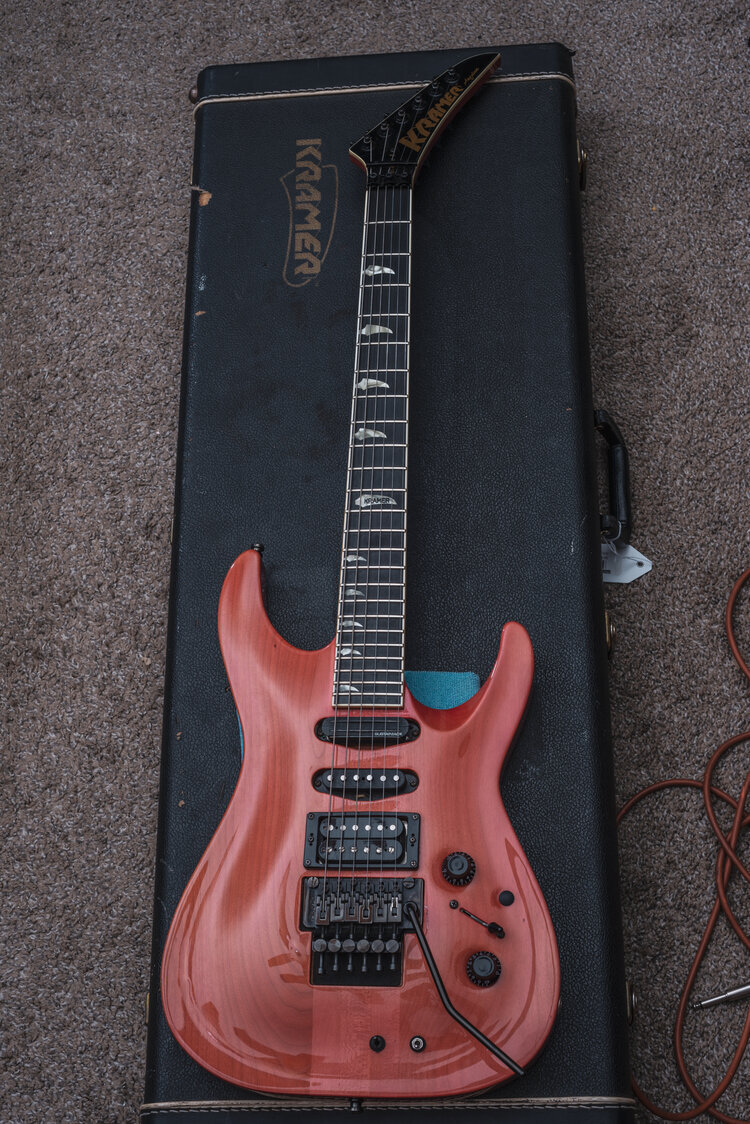
New Guitar: Kramer Stagemaster Mach II - Flat Top

Another awesome neck-through Kramer added to the collection, and in the same exact color as my arch top Mach II Stagemaster! This color in the catalogs was called “Rose,” it’s essentially a transparent coral/salmon color. It’s a beauty - and really cool to have both flat top and arch top variations of the same guitar. I’m a big fan of EMG’s and this one is equipped with the common 81/SA/SA combination, a modification I probably wouldn’t have done myself but I’m pleased with anyway. The previous owner also added an extra, non-matching knob in place of the coil tap switch. That won’t do, so I’ll be fixing that up shortly, perhaps a vintage EMG 89 would be a great addition here, and I could keep the stock looking coil tap switch, assuming there’s no major damage under the finish where the new knob was added.

Here are some pictures comparing the flat top to the arch top.

New Guitar: Ibanez 540S Carribean Blue

Picked up this guitar from Guitar Center - again - labeled as a “540S.” This is certainly an interesting combination and one I’m still trying to figure out - it’s a 1989 Carribean Blue 540S body, complete with the Bensalem PA neck plate (blank serial number), but the neck has a serial number dating it to 1996. Even more interesting, the neck has the “S series” badging, and abalone inlays - but they are dots instead of ovals. Also, it is not an all-access neck joint… from my digging, any S series guitar with a Fujigen made neck after about 1993 should have this neck joint type. I can’t find any stock 1996 S series guitar - even in Japan or European catalogs - that has abalone ovals and a traditional neck joint.

NFX_0874.jpg

I also took some measurements, it is Wizard dimensions as well - and a very high quality build with the flat 17” fretboard just like my others. I’m not sure what to make of this neck, but strange features and history aside, it is an amazing player like any of my other Ibanez guitars. It’s not hard to imagine why Ibanez was able to weather the storm during the 90s while many of their competitors struggled, got bought out, or went overseas during the same period.

New Guitar: 1990 ESP Horizon Deluxe

Here’s a pretty unique one - a Bolt-on neck Horizon. Picked this up browsing Guitar Center’s listings for a fair price, and it has a really sweet arched top body shape with a great neck.

This also has a later iteration of the Sinclair bridge, ESP’s take on the Floyd Rose. These are great bridges, just as good as any OFR but with one major flaw - the saddles have offset screw holes and no one I can find makes replacement saddles. So don’t break one!

To make matters worse, the angular shape of the base plate on the Sinclair means a Floyd, Gotoh, or Edge trem will not just drop in - the body needs to be routed to fit a more squared-off base plate. I’ve seen too many hack-jobs over the years where someone tried to make a different bridge fit. I’m lucky and have a spare Sinclair bridge with 5 good saddles on it, so if I ever break one I have a few - but I understand most people who own these vintage ESP’s wouldn’t have access to that. If anyone happens to know a shop that can build a replica saddle based on a sample, please let me know and I’d be happy to supply some saddles from my spare to get it made… I’d love to keep this bridges alive into the future.


New Guitar: 1982 Kramer "The Pacer"

I have wanted a Kramer with the Rockinger bridge for a while. I know it’s an objectively inferior tremolo to a Floyd Rose, but since it was the original “Edward Van Halen Tremolo,” it has a certain value from a historical/collector’s standpoint - and that’s me.

I watched this one sit unsold for over a month, wondering when and if it would sell and at what price. Eventually it came down and I had to consider it - so I made a deal on it.

NFX_0817.jpg

Not only is this my first guitar with a Rockinger, but it’s also the first guitar I’ve owned with the traditional strat configuration of three single coil pickups. Most of the music I play calls for a humbucker in the bridge position, so this guitar won’t be the most versatile, but after playing it I have sorely been missing the positions 2 and 4 “quack” - and a split humbucker does not have the same snap that a true single coil has in this position for sure. Coupled with a clean amp, and occasionally switching on a light overdrive, there are so many great tones in this guitar.

The condition is excellent with only a couple of small dings - sadly the largest of which came from a loose screw inside the case during shipping. It also included the original warranty card, case keys, and inspection tag - very cool. Despite collecting tons of Kramers over the years, I’ve yet to get a set of these so that’s really cool to have.

New Guitar: Charvel Model 4 Rainbow Crackle!

Wow! I spotted this one online at GC, and it had no picture - but it was described as a Model 3DR “Rainbow Crackle.” I figured for the price, I’d risk the purchase and find out what kind of condition it was since I can always return it if I don’t like it.

Luckily, there’s no danger of that, this is a fantastic guitar. It’s not a 3DR, it’s a Model 4, but that is fine with me. In fact, I might prefer that because I’m a big fan of the shark tooth inlay necks and the HSS pickup config is so useful across a variety of styles. This came with the factory J50BC and J200 pickups, the JE-1200 mid boost circuit, and JT-6 trem - just like my other two Model 4’s - but in the interest of a change of pace, I’ve already swapped out the J50BC with a zebra Dimarzio Super Distortion. This pickup previously lived in my Charvel Fusion, but has been unused for a while since I sold that guitar months ago.

I think this pickup might have too strong of a midrange to really cooperate with the JE-1200 mid boost, but that’s ok. Since the mid boost is not that clearly different sounding in the bridge position, it means I can set it however I like for the neck and middle single coils and not worry about how the sound will change when I need to use the bridge position.

The real highlight here is the finish of course, otherwise it’s just a standard and great sounding Model 4. The finish is a transition from blue to red to yellow crackle, and there is a little bit of a fade in between them. There are some purple and orange hues visible in thinner stripes between the colors, but it’s not as clear as the primary colors.

This is my first crackle job Charvel, and I’m also surprised to see it has a very slight texture visible through the top finish when looking at it under the light or at a shallow angle. Overall this is one of the coolest finishes on any guitar I own, and I think the very tight pattern looks great. Looking around the web, I’ve seen other crackle jobs that are a bit more spread out with more black in between the colors, I think those look really cool too and I’d love to have both variations someday.

New Guitar: BC Rich ST-III Ice Blue

After enjoying some time with the natural color ST-III I acquired barely 2 months ago, I really wanted to have another in another color. This one popped up on ebay with the original case, paperwork, and in excellent condition and I had to pick it up.

It arrived in extremely good condition, other than a few small nicks on the top of the body it’s in superb shape for the age. This is another 1987 model, but this time fitted with the factory pickups - two single coils and a humbucker all made by Dimarzio. These pickups do not have model numbers, as Dimarzio provided a lot of OEM specific models that don’t necessarily have a direct comparison to a pickup in their catalog (Dimarzio did this for Ibanez and others). The single coils are very low output, proper vintage sounding, and the humbucker surprised me - medium to low output with a really flat response. I was expecting a higher output, mid-heavy pickup as was the style in this era and especially on a guitar like the ST3 which I assume was aimed more at the shred and rock/metal players.

Of course I have plenty good to say about the Ibanez Edge bridge and the neck, which has a lovely bare feel and a super thick rosewood fretboard. I know it’s tough to do a fair comparison between two guitars that are over 30 years old now, but this one feels very consistent with the other ST-III I have. Both play very similarly, with similar body weights and identical necks. Any tonal differences seem to be just from the different pickups and body finish than anything with the construction of the guitars, which is always a good sign - as a big Kramer collector, I’m not used to very consistent quality control!

I’ve also done some digging and found some details on these guitars from the catalog. It appears these two are both relatively mundane models, but they could be ordered with maple or ebony fingerboards, binding, graphic paint jobs, or even neck-through configurations. I’d love to see an ST-III with a bound maple board, what a cool guitar that would be - and based on some of the other custom configurations I’ve seen around the web I’m sure there’s probably one out there.

New Guitar: BC Rich ST-III with Roland GK setup

I’ve always liked the look of these and they have a pretty unique history, coming out in the late 80s during a time when BC Rich was struggling financially and eventually ended up selling their brand name to Class Axe. This guitar is from before the sale, in 1987 - USA made and a very fine quality instrument. These also used top mounted Ibanez Edge tremolos, which were very new at the time and are close to OFR quality - some even prefer these trems to OFR’s and I can see why.

I picked this one up for a great price from Guitar Center, and it came equipped with a Roland GK-2A pickup. I doubt the natural finish is original, but if the original color was stripped they did a very clean job and the light satin finish is very well done. I’ve never had a Roland GK before either, so I look forward to trying it out - my initial look at Youtube videos makes this system look extremely cool and I’d love to be able to play some synthesizer or saxophone parts on my guitar!

In addition to the satin finished body, the neck is also a very bare wood feeling on the back, with an extremely thick slab of rosewood for the fretboard. When it arrived, this guitar had a Parallel Axis PATB-3 pickup in the bridge position, which is a sweet sounding pickup if a little lower output than I usually prefer in the bridge position, and a Quarter Pounder in the neck which is a highlight - I’m surprised just how much I like this high output, bassy single coil pickup.

New Guitar: Charvel Model 2 Electric Blue

Another guitar center find, this one popped up online for a very reasonable price that I could not refuse. It arrived and is in surprisingly great condition besides a small light colored mark on the top edge of the body - it looks a little bit like paint, like you would use on the walls of your house. It also came equipped with a Seymour Duncan SH-12 Screamin’ Demon, one of my favorite humbuckers for its thick tone and with a single pickup, a versatile one like this helps make it more practical when rolling off the volume than other high output pickups.

New Guitar: Charvel Model 3A '86

I picked this up as a bit of a change in pace compared to my other Charvels - this one is equipped with a Kahler, USA made, fulcrum tremolo called the “2520.” This trem is similar in design to a modern strat trem, with two anchor points instead of the traditional six, and the addition of fine tuners to pair with the locking nut at the headstock. While it’s not a true double locking, floating tremolo like a Floyd Rose, it’s actually a very good bridge - and quite forward thinking for the time. It gets a pretty bad rap around the web, but I was impressed with it, although my expectations were low which helps. The biggest detractor is that the spacing of the studs is too close for a direct swap with just about any other bridge - anyone who had an ‘86 Model 2 or Model 3 with this bridge would have to plug and re-drill holes in order to upgrade the bridge to something else.

I personally would never modify an original like this one, which happens to be in fantastic shape. The factory J80C pickups are meaty and thick sounding, similar to Duncan Customs, and I think this pickup sounds incredible in the neck position even if a bit high output. As long as the heights are adjusted, the volume difference isn’t too bad, and a 3-way blade switch makes it easy to switch between them. Later 3A’s had the 5-way blade switch, which gives split coil sounds in positions 2 and 4 but this particular one is too early for that feature.

Two Single-Humbucker Guitars, One Weekend

It’s been an eventful few days here. My replacement Proaxe neck arrived and is bolted up now finally (thanks UPS), along with acquiring another very special neck (no spoilers yet!). Plus, two new guitars through the door just in time for Thanksgiving - a 1987 Charvel Model 5A in “Black Cherry” finish and a 1989 Kramer Baretta I in “Snakeskin.” Now that’s a rare color!

I actually know an owner of the snakeskin Baretta, it’s changed hands quite a few time since he’s had it, going from east coast USA to west coast, then all the way to the UK, before finally landing back here with me in Florida. It’s a shame in that time it has seen a few mods, such as a hole for a strap button on the rear of the upper horn, jack plate added, and a mini switch added. Still, it’s a great player and certainly eye catching.

The Model 5A came from Guitar Center, nothing too exciting about that, until I picked it up and played it. Wow, that neck through design can really get very low action without much setup effort and it really wails now that I’ve removed the 25k pot (somebody must’ve had EMG’s in this before) and put in a 500k and Jackson J90C pickup.

A few teasers:

As always, there will be more pictures and details on their respective pages.

Baretta I Details

Model 5A Details

Happy Thanksgiving!